
Listening
Employee engagement survey questions: 36 examples, and what to do next
Most engagement surveys ask good questions. Where they fail is afterwards, when the results come back and nothing visibly changes. Here are the questions worth asking, and how to make sure the answers lead somewhere.
The short answer: good employee engagement survey questions are short statements that people rate, such as "I'm clear about what good looks like in my role" or "I can raise a problem without fear of being blamed". Cover trust, direction, values, strengths, ownership and wellbeing, keep a team pulse to 10 to 15 questions, and always share the results and act on at least one thing.
Before you write any employee engagement survey questions
If you work in a large organisation, you probably don't write the annual engagement survey. HR does, often with a specialist provider. Your job as a manager is different and arguably more important: making sense of your team's results, and running quick check-ins in between so you're not flying blind for a year.
Either way, the questions only matter if something happens afterwards. Asking people for their views and then doing nothing is worse than not asking at all, because it teaches them that speaking up is pointless.
How to write good survey questions
- Use statements people rate. "I'm clear about what good looks like in my role" on a scale from strongly disagree to strongly agree is easier to answer and compare than an open question.
- One idea per question. "My manager is supportive and gives clear direction" is two questions. People can't answer both at once.
- Ask about things the team can change. Questions about the canteen or the pension scheme won't help you lead your team.
- Keep it short. For a team check-in, 10 to 15 questions is plenty. Add two or three open questions at the end.
- Make it anonymous, and mean it. In a small team, don't report results by sub-group, or people will work out who said what.
- Ask the same core questions each time, so you can see what's moving.
36 employee engagement survey questions
These are written as statements for people to rate, from strongly disagree to strongly agree. They're grouped around the six foundations of an engaged team from the book Be More Human. Choose two or three from each group for a short team pulse.
Trust and safety
- I can raise a problem or admit a mistake without fear of being blamed.
- I trust the people on my team to do what they say they'll do.
- My manager backs me when things go wrong.
- People on this team are honest with each other, even when it's uncomfortable.
- I feel I can be myself at work.
- When I disagree with a decision, I feel able to say so.
Direction and a shared story
- I understand where our team is heading and why it matters.
- I can see how my work contributes to the organisation's goals.
- I had a say in shaping our team's goals.
- I'm clear about what good looks like in my role.
- Our team's priorities are clear, even when things change.
- I believe our team can achieve what we've set out to do.
Values in action
- Our organisation's values show up in how decisions are made in this team.
- People here are recognised for living our values, not just for hitting targets.
- When someone acts against our values, it's dealt with fairly.
- The way we work matches what our leaders say is important.
- I'm proud to tell people where I work.
- I'd recommend this team as a great place to work.
Strengths and growth
- Most of my week is spent on work that plays to my strengths.
- My manager knows what I'm good at.
- I've had a conversation about my development in the last six months.
- I'm learning and growing in this role.
- My work makes good use of my skills.
- Good work gets noticed on this team.
Ownership and accountability
- People on this team take responsibility when things go wrong, rather than blaming others.
- Commitments made in our meetings get followed through.
- I have the freedom to decide how I do my work.
- Our processes and systems help me get things done rather than slow me down.
- Poor performance is addressed fairly on this team.
- I feel my contribution makes a real difference.
Wellbeing and pressure
- My workload is manageable most of the time.
- When the pressure is on, our team pulls together.
- My manager takes an interest in how I'm doing, not just in what I deliver.
- I can switch off from work when I need to.
- We talk about how people are really doing, not just about the work.
- I see myself still working here in two years' time.
Three open questions to finish
- What's one thing we should keep doing as a team?
- What's one thing that gets in the way of you doing your best work?
- If you were leading this team for a month, what's the first thing you'd change?
Want a faster read? The free team assessment covers the same six areas in 12 statements and scores them instantly. Ask your team to take it too and compare answers.
What to do with the results
This is where most surveys fail. The numbers come back, a deck is made, and nothing changes for the team. A few principles help.
-
Expect the first answers to be cautious
People rarely tell you the whole truth the first time they're asked, especially about you. They give part of it, then watch how you react. If you argue or explain it away, that's the last honest feedback you'll get. Thank them, write it down and sit with it, even when it stings.
-
Share the results with the team quickly
Within a couple of weeks, while people still remember answering. Share the low scores as well as the high ones.
-
Talk about what's behind the numbers
A score tells you where to look, not what's wrong. The conversation with your team is where you find out. Use the template below.
-
Pick one thing, not ten
One visible change that the team chose will do more for trust than a long action plan nobody reads.
-
Close the loop
Tell people what you changed because of what they said. Next time you survey, they'll be more honest, because they've seen it matters.
Free template: the survey results team conversation
Copy this into your meeting invite or notes.
Team conversation: our survey results
1. Thank people (2 minutes)
Thank everyone for being honest. Say clearly that you want to hear what's behind the numbers, and that nobody will be in trouble for what they say.
2. What stands out (10 minutes)
Where are we strongest? Where are we weakest? What surprised you?
3. What's behind the lowest score (15 minutes)
What does this look like day to day? What gets in the way? What would good look like?
4. Pick one thing (10 minutes)
Of everything we've discussed, which one change would make the biggest difference? What will we each do in the next 30 days?
5. Agree how we'll know (5 minutes)
When will we check progress? Who owns it? Date for the next conversation: [date].
Actions
- [Action], [owner], by [date]
- [Action], [owner], by [date]
Try this week: pick six questions from the list above, one from each group, and ask your team to rate them anonymously. Share the results at your next team meeting and ask just one question: "What's behind the lowest score?"
Questions people ask
How many questions should an employee engagement survey have?
An organisation-wide survey often has 30 to 60. For a quick team pulse between annual surveys, 10 to 15 rated statements and two or three open questions are enough.
Should engagement surveys be anonymous?
Yes. People answer more honestly when they know they can't be identified. In small teams, avoid breaking results down by sub-group, or individuals can be identified.
How often should you run an engagement survey?
Most large organisations run a full survey once a year. Managers get more value from short team pulses every quarter in between, so they can see whether changes are working.
What should a manager do after an engagement survey?
Share the team's results quickly, talk with the team about what's behind the lowest scores, agree one change together, and tell people what changed because of what they said.
Related guides
Sources
The stories and practical ideas on this page come from the book. The figures in the blue boxes come from the published research below.
- Earl, J., Lampe, M. D. and Buksin, A. (2006). What to Do With Employee Survey Results. Gallup.
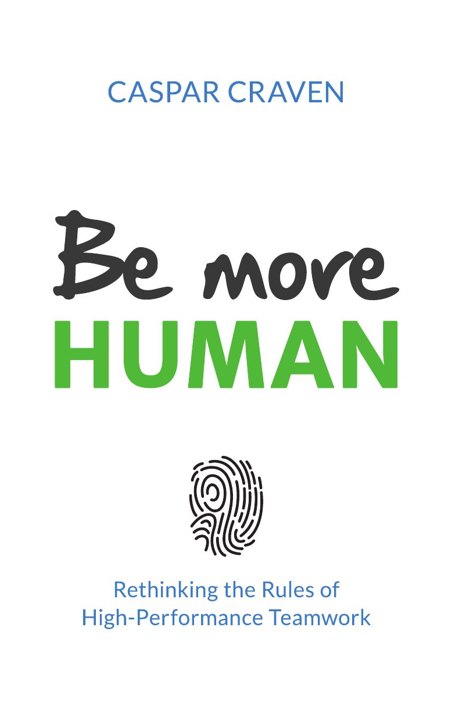
From the book Be More Human
The ideas and stories on this page come from Be More Human: Rethinking the Rules of High-Performance Teamwork by Caspar Craven: what he learnt, often the hard way, about building teams in business, at home and at sea. It's written for anyone asking why their team isn't getting the results it could, or what's wrong with the culture.